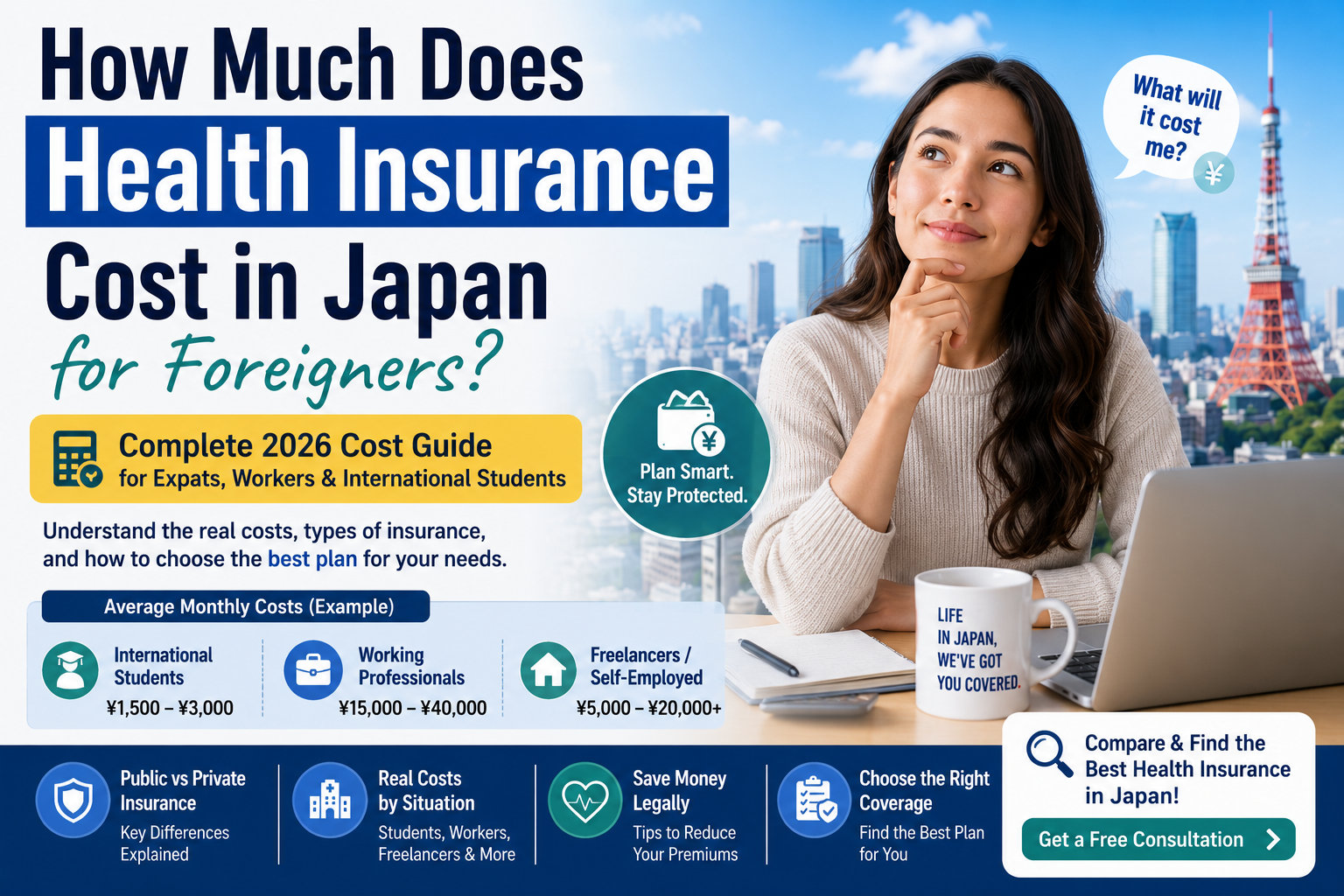
One of the first questions many foreigners ask after moving to Japan is: how much does health insurance actually cost? The answer depends on several factors — your employment status, income, age, and whether you’re using public or private insurance. This guide breaks down realistic cost expectations for students, employees, freelancers, and long-term residents.
- Is Health Insurance Mandatory in Japan?
- How Much Does National Health Insurance Cost?
- How Much Does Employees’ Health Insurance Cost?
- What Does Public Insurance Cover?
- Do Foreigners Need Private Insurance Too?
- How Much Does Private Health Insurance Cost?
- How Expensive Is Healthcare Without Insurance?
- Ways to Manage Your Insurance Costs
- Public vs. Private Insurance Cost, at a Glance
- Frequently Asked Questions
- Related Guides
Is Health Insurance Mandatory in Japan?
Yes. Foreign residents staying in Japan for more than three months are generally required to join either National Health Insurance (NHI / Kokumin Kenko Hoken) or Employees’ Health Insurance (Shakai Hoken), depending on their employment situation.
How Much Does National Health Insurance Cost?
NHI premiums are based primarily on your income, your municipality, and household size, so the exact amount varies depending on where you live. As a general guide:
| Situation | Estimated Monthly Cost |
|---|---|
| Students and low-income residents | ¥2,000–¥15,000 |
| Freelancers with moderate income | ¥15,000–¥30,000+ |
| Higher-income residents | Scales up further, though NHI has an annual cap |
Why are student premiums often low?
Many international students pay relatively low premiums because their reported annual income is limited, and many municipalities offer premium reductions for low-income residents. This is one reason Japan is considered relatively affordable for international students compared to some other countries — though the reduction typically requires an application, not automatic enrollment at a discount.
How Much Does Employees’ Health Insurance Cost?
If you work full-time in Japan, your employer will typically enroll you in Employees’ Health Insurance (Shakai Hoken), which bundles together health insurance and pension contributions (Kosei Nenkin).
The combined employee share is typically around 14–15% of your standard monthly salary — roughly split between health insurance (around 5%) and pension contributions (around 9%), both matched by an equal employer contribution. So on a monthly salary of ¥300,000, you might expect somewhere in the range of ¥40,000–¥45,000 deducted for combined health insurance and pension, though the exact figure depends on your prefecture and the specific health insurance association (kenpo) your employer uses.
This is a meaningfully larger deduction than health insurance alone, since it includes your pension contribution — but in exchange, your employer matches the full amount, and you’re building pension credit alongside your health coverage.
What Does Public Insurance Cover?
Both NHI and Employees’ Health Insurance generally cover:
- About 70% of standard medical costs
- Hospital treatment and doctor visits
- Surgery
- Prescription medication
- Some dental treatment
You’re generally responsible for the remaining 30% at the time of treatment.
Do Foreigners Need Private Insurance Too?
It’s not required. Public insurance provides solid baseline coverage. That said, many foreigners choose to add private insurance for:
- Better hospitalization coverage
- English-language support
- International coverage when traveling
- Access to private hospital rooms
For a deeper look at when private insurance makes sense, see: National Health Insurance vs Private Insurance in Japan
How Much Does Private Health Insurance Cost?
Private plan pricing varies by age, coverage level, and provider. As a general range:
| Age | Estimated Monthly Cost |
|---|---|
| 20s | ¥2,000–¥4,000 |
| 30s | ¥3,000–¥6,000 |
| 40s | ¥5,000–¥8,000 |
| 50s+ | ¥8,000–¥15,000+ |
Actual pricing also depends on your medical history, coverage level, and family size — get a specific quote rather than assuming a flat rate.
How Expensive Is Healthcare Without Insurance?
Significantly more expensive. Rough examples of out-of-pocket costs without any insurance:
| Treatment | Approximate Cost Without Insurance |
|---|---|
| Basic clinic visit | ¥5,000–¥15,000 |
| MRI scan | ¥40,000–¥100,000 |
| Hospitalization | Several hundred thousand yen |
| Surgery | ¥500,000+ possible |
This is why enrollment isn’t just a legal requirement — it’s a meaningful financial safeguard. For more on this, see: What Happens If Foreigners Don’t Have Health Insurance in Japan?
Ways to Manage Your Insurance Costs
- Ask about premium reductions if your income is low. Many municipalities offer NHI reductions for students and low-income residents, but this typically requires an application — it’s not automatic.
- Keep your income records accurate. NHI premiums are calculated based on reported income, so accuracy matters for getting the right rate.
- Compare private plans carefully rather than choosing the cheapest. The lowest-cost plan isn’t always the best value once you account for coverage gaps.
- Match your coverage to your actual situation. A young, healthy single resident has different needs than a family or someone with ongoing health considerations.
Public vs. Private Insurance Cost, at a Glance
| Insurance Type | Monthly Cost | Main Benefit |
|---|---|---|
| National Health Insurance | Income-based | Affordable public healthcare |
| Employees’ Health Insurance | Salary-based (~14-15% combined with pension, employer-matched) | Strong employer-backed coverage |
| Private Insurance | Fixed premium | Additional protection and support |
Frequently Asked Questions
Can foreigners use Japan’s public healthcare system? Yes — foreign residents legally living in Japan are generally eligible, and in most cases required, to enroll in public health insurance.
Is health insurance free in Japan? No. Monthly premiums are required under both NHI and Employees’ Health Insurance.
Can tourists join Japan’s public health insurance? No. Public insurance is available to registered residents, not short-term visitors. Tourists should use travel insurance instead.
Is Japanese healthcare considered good value? Generally yes — Japan has a well-regarded healthcare system, and for enrolled residents, costs are relatively predictable compared to countries without universal coverage.
Related Guides
- What Insurance Do Foreigners Need in Japan?
- Health Insurance for Foreign Workers in Japan
- National Health Insurance vs Private Insurance in Japan
Note: Premium figures in this article are general estimates for illustration purposes. Actual costs depend on your income, municipality, age, prefecture, and specific plan. Confirm exact figures with your municipal office, employer, or insurance provider directly.