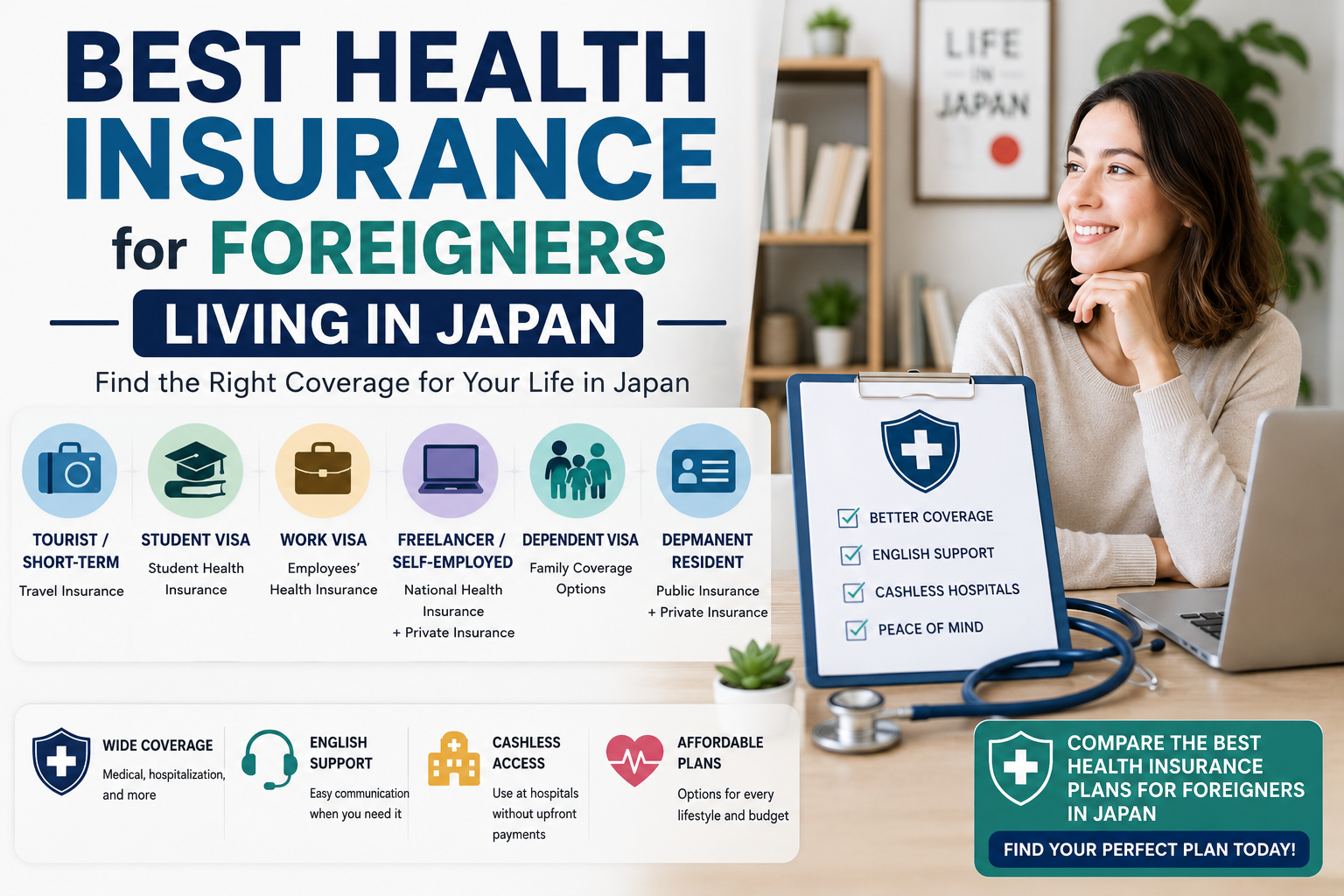
Japan offers one of the most reliable and affordable universal healthcare systems in the world — but figuring out which insurance actually applies to you as a foreigner can be genuinely confusing. The rules differ depending on whether you’re a full-time employee, a student, a freelancer, or running your own business, and most general guides don’t walk through the practical differences in enough detail to actually help you decide.
This guide breaks down the three main insurance paths available to foreign residents in Japan, what each one actually costs, who’s required to use which, and how private insurance fits into the picture for those who want additional coverage.
- Table of Contents
- How Japan’s Health Insurance System Works
- 1. Employees’ Health Insurance (Best for Full-Time Workers)
- 2. National Health Insurance (Best for Students, Freelancers & the Self-Employed)
- 3. Private Health Insurance (Best for Extra Coverage & English Support)
- Public vs. Private: Side-by-Side Comparison
- How Much Does Health Insurance Actually Cost in Japan?
- Which One Should You Choose?
- Frequently Asked Questions
- Sources & Further Reading
- Related Guides
Table of Contents
- How Japan’s Health Insurance System Works
- Employees’ Health Insurance (Shakai Hoken)
- National Health Insurance (NHI)
- Private Health Insurance
- Public vs. Private: Side-by-Side Comparison
- How Much Does It Actually Cost?
- Which One Should You Choose?
- Frequently Asked Questions
How Japan’s Health Insurance System Works
Japan runs a universal healthcare system, meaning nearly every resident — Japanese national or foreign — is required to be enrolled in some form of public health insurance once they’ve registered as a resident. Public insurance typically covers around 70% of medical costs, leaving patients responsible for roughly 30% out of pocket at the point of treatment.
There are two public insurance systems that residents fall into depending on their employment situation:
- Employees’ Health Insurance (Shakai Hoken) — for full-time employees
- National Health Insurance (NHI / Kokumin Kenko Hoken) — for everyone else: students, freelancers, the self-employed, and part-time or unemployed residents
On top of one of these two, many foreign residents also choose to add private health insurance for extra coverage, English-language support, or access to specific hospital networks.
1. Employees’ Health Insurance (Best for Full-Time Workers)
If you’re employed full-time by a Japanese company, you’ll typically be automatically enrolled in Shakai Hoken by your employer — this isn’t something you sign up for yourself.
Who this applies to
- Full-time company employees
- Long-term work visa holders employed by a Japanese company
- Employees meeting minimum working-hour thresholds (part-time staff working close to full-time hours may also qualify, depending on company size and contract terms)
Main benefits
- Premiums are split between you and your employer, roughly halving your direct cost compared to paying alone
- Includes enrollment in Japan’s pension system (Kosei Nenkin) alongside health coverage
- Eligible dependents (spouse, children) can often be added under your coverage at no extra premium
- Generally the lowest net cost among the three options, since your employer absorbs half the premium
Things to be aware of
- You don’t get to choose your insurance provider — it’s tied to your employment
- If you change jobs or leave full-time employment, your coverage typically ends and you’ll need to transition to NHI
- Coverage details and add-on benefits can vary somewhat depending on which specific health insurance association (kenpo) your employer uses
2. National Health Insurance (Best for Students, Freelancers & the Self-Employed)
If you’re not covered through an employer — because you’re a student, freelancer, self-employed, working part-time, or between jobs — you’re required to enroll in National Health Insurance through your local municipal office once you register your address.
Who this applies to
- International students
- Freelancers and self-employed residents
- Part-time workers not meeting full-time insurance thresholds
- Unemployed residents (including those between jobs)
Main benefits
- Available to essentially anyone with residency status, regardless of employment
- Covers the same 70% of standard medical costs as employer-based insurance
- Premium reductions are available for low-income residents, including many students (though this typically requires an application, not automatic)
- Accepted at the vast majority of clinics and hospitals throughout Japan
Things to be aware of
- You pay the full premium yourself — there’s no employer contribution
- Premiums are calculated based on income and vary by municipality, so the exact amount depends on where you live
- English-language support at enrollment counters varies significantly by city — larger cities tend to have better support than rural areas
3. Private Health Insurance (Best for Extra Coverage & English Support)
Private insurance in Japan isn’t a replacement for NHI or Shakai Hoken — it’s a supplement. Many foreign residents choose to add a private plan on top of their public coverage for the gaps public insurance doesn’t fill.
What private insurance typically adds
- English-speaking customer support and claims handling
- Cashless payment at partner hospitals and clinics (rather than paying upfront and filing for reimbursement)
- Higher reimbursement limits for specialist treatment or hospitalization
- Access to international hospital networks, which can matter if you travel frequently or split time between countries
- Additional services like medical evacuation or coverage for treatment outside Japan, depending on the plan
Who tends to benefit most
- Families who want broader coverage and English support for the whole household
- Long-term residents who want the reassurance of comprehensive private coverage
- Professionals whose employer coverage doesn’t include family members
- Anyone who’s found navigating the public system in Japanese difficult and wants dedicated English support
Providers commonly used by foreign residents in Japan for this kind of supplemental coverage include international insurers such as Cigna Global and IMG (International Medical Group) — both offer plans built around English-language support and international hospital networks, which is often the main draw for residents choosing to add private coverage.
(Full comparison table with current plans coming soon.)
Public vs. Private: Side-by-Side Comparison
| Employees’ Health Insurance | National Health Insurance | Private Insurance | |
|---|---|---|---|
| Best for | Full-time employees | Students, freelancers, self-employed | Anyone wanting extra coverage |
| Who pays | Split with employer | You pay in full | You pay in full |
| Enrollment | Automatic via employer | You register at your municipal office | You apply directly with the provider |
| English support | Depends on employer/kenpo | Varies by municipality | Generally strong |
| Covers dependents | Often, at low/no extra cost | Each resident enrolls individually | Depends on plan |
| Replaces public insurance? | N/A (this is the public option) | N/A (this is the public option) | No — supplements it |
How Much Does Health Insurance Actually Cost in Japan?
Costs vary significantly based on your income, your municipality, and which type of insurance you’re enrolled in. Here’s a realistic breakdown of what to expect.
Employees’ Health Insurance
Premiums are calculated as a percentage of your monthly salary. Combined health insurance and pension contributions typically come to around 14–15% of your standard monthly salary on the employee side, split evenly with an equal employer contribution (so the employer effectively matches what you pay). This means your actual cost scales directly with your income. For example, on a monthly salary of around ¥300,000, combined employee contributions are commonly in the range of ¥40,000–¥45,000, though the exact figure depends on your prefecture and the specific health insurance association your employer uses.
National Health Insurance
Premiums are based on your previous year’s income and set at the municipal level, so the exact amount varies depending on where you live. As a rough guide:
- Students and low-income residents: often in the range of ¥2,000–¥15,000 per month, especially with an approved premium reduction
- Working freelancers with moderate income: commonly ¥15,000–¥30,000+ per month
- Higher earners: premiums scale up further, though NHI does have an annual cap
These figures are general estimates — your municipal office or an online NHI calculator can give you a number specific to your income and address.
Private Insurance
Private plans vary widely based on coverage level, age, and whether you’re insuring just yourself or a family. As a general range, basic supplemental plans often start around ¥3,000–¥8,000 per month, while more comprehensive plans with higher coverage limits and broader hospital networks can run ¥10,000–¥20,000+ per month.
Which One Should You Choose?
- Full-time employees: You likely don’t have a choice to make — Shakai Hoken will be arranged through your employer automatically.
- Students: National Health Insurance, generally with a premium reduction application at enrollment.
- Freelancers and self-employed residents: National Health Insurance is required; many in this group also add private insurance for English support and higher reimbursement limits.
- Families: Public insurance covers the essentials, but private insurance is worth considering for broader family coverage and English-language support during medical visits.
- Anyone prioritizing English support or cashless treatment: Consider adding private insurance regardless of which public option you’re enrolled in — it’s designed to work alongside your public coverage, not replace it.
Frequently Asked Questions
Can I choose between Employees’ Health Insurance and National Health Insurance? Generally no — which one applies to you is determined by your employment status, not personal preference. Full-time employees are enrolled in Shakai Hoken by their employer; everyone else uses NHI.
Do I need private insurance if I already have NHI or Shakai Hoken? It’s not required. Public insurance covers the large majority of standard medical care. Private insurance is an optional addition for people who want English support, cashless treatment, or higher coverage limits.
Can my spouse and children be covered under my insurance? Under Employees’ Health Insurance, dependents can often be added at little or no extra premium. Under National Health Insurance, each resident (including family members) typically needs to enroll individually, with premiums calculated per household.
What happens if I switch from a full-time job to freelancing? You’ll need to deregister from Employees’ Health Insurance and enroll in National Health Insurance at your municipal office. This isn’t automatic — you need to handle the transition yourself.
Is dental care covered under public insurance? Basic dental treatment is generally covered under both Employees’ Health Insurance and NHI, though certain cosmetic or specialized procedures may not be.
How long does it take to get an insurance card after enrolling? For NHI, cards are typically mailed within one to two weeks after enrollment, though this varies by municipality. Ask about a temporary certificate if you need to see a doctor before your card arrives.
Are pre-existing conditions covered? Public insurance (NHI and Shakai Hoken) generally covers treatment regardless of pre-existing conditions. Private insurance policies may have exclusions or waiting periods for pre-existing conditions — check the specific plan’s terms.
Can tourists or short-term visitors use these insurance options? No — National Health Insurance and Employees’ Health Insurance are for residents who have registered an address in Japan. Short-term visitors typically need separate travel insurance instead.
Sources & Further Reading
- Ministry of Health, Labour and Welfare (Japan)
- Japan Health Insurance Association (Kyoukai Kenpo) — official information on Employees’ Health Insurance
- Your local municipal office (city/ward) — for National Health Insurance premium calculations specific to your address and income
This article is written and maintained by the Japan Insurance Guide team. We research each guide using official government and municipal sources, and update our content as procedures or requirements change. Read more about our approach on our About Us page.
Related Guides
- What Insurance Do Foreigners Need in Japan?
- Is Japanese National Health Insurance Mandatory for Foreigners? (Complete Guide)
- How Much Does Health Insurance Cost in Japan for Foreigners?
Note: Premium figures and cost ranges in this article are general estimates for illustration purposes. Actual costs depend on your income, municipality, age, and specific plan. Confirm exact figures with your municipal office, employer, or insurance provider directly.